
PILOTS
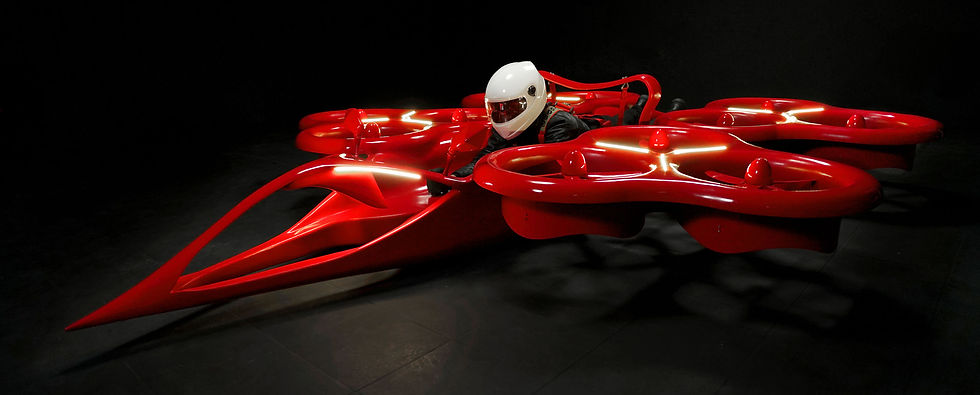
The pilots will race, so at the end of the championship, the best pilot will be awarded the title of world champion
What it takes to be an ArcaBoard racing pilot
Resembling a futuristic low-level attack aircraft, the ArcaBoard 2 competing in the ArcaBoard World Championship will be piloted by exceptional pilot-athletes in an extremely demanding, combat-like environment. The pilot will need to navigate at high speed at low altitude above ground, process data received from their team, race control and marshals, make the necessary decisions to overtake competitors and execute pit stops, sometimes in difficult weather conditions.
Therefore, pilots competing in the ArcaBoard World Championship must be elite athletes able to demonstrate phisical and psychological performance comparable to that of pilots flying low-altitude attack aircraft.
These performance requirements are important because, despite the advanced technology of the ArcaBoard 2 vehicle, the ArcaBoard World Championship is essentially a sporting competition in which the skill and talent of the pilots must be a key factor in determining the winner.
They require an in-depth understanding of engineering and must be extremely physically fit, with strength and endurance, since the ArcaBoard moves in response to their body movements, which modify the vehicle’s overall centre of gravity.
They must also exhibit exceptional mental balance in order to pilot the vehicles at high speeds and make complex decisions in split seconds, while processing a high volume of data from the pit stand and the onboard displays in all weather conditions.
Other exceptional traits include courage and instinct, which allow them to make split-second decisions during overtaking, especially in unpredictable weather.
For a pilot, the title of World Champion brings worldwide recognition of their achievement and prize money.

Racing License
To become an ArcaBoard racing pilot, candidate pilots must obtain the ArcaBoard Racing Licence. This consists of a series of courses and exams that must be passed.
Once the licensing process is complete, the pilots will be added to a pool from which competing teams can select their main and reserve pilots.
Alternatively, teams can select their own pilots, who must also undergo the same licensing process.
To obtain an ArcaBoard racing licence, pilots must complete classroom-based training in theory and practice, covering ArcaBoard systems, communication, weather, racing manoeuvres, emergency procedures and pit stops.
During the theoretical training, pilots learn how the ArcaBoard works, how the vehicle controls its movement and how bad weather impacts the vehicle. They will also learn how to communicate with the pit crew, as well as the relevant rules and standards.
During practical training, pilots apply their theoretical knowledge in the cockpit. They will learn to take off, land and fly the ArcaBoard independently once the instructor is confident in their abilities. They will also practise handling situations such as motor and battery failures and pit stops.
The courses last two weeks.
ArcaSpace is committed to reducing the financial burden on the candidate pilots for the first Championship season.
ArcaSpace will announce in due time when applications open for the ArcaBoard Racing Licence in 2026.
Places on the courses will be limited and participants will be admitted on a first come, first served basis.

Necessary steps
To race in the ArcaBoard World Championship, a pilot must pass three phases:
- The pilot candidacy registration to obtain the ArcaBoard Racing Licence can be submitted at any time up to six months before the Championship begins.
- The pilot must obtain the ArcaBoard Racing Licence to race in the Championship.
- Registration with a Championship racing team and official announcement as a pilot for the racing team.
To secure your place and receive priority access to obtain the ArcaBoard Racing License, register your non-binding interest to obtain an ArcaBoard Racing License at contact@arcaboard.com
The registrants will be informed ten days before the start of the Racing Licensing course, during which time they can decide whether to go through the actual licensing process.